IP & bandwidth, native
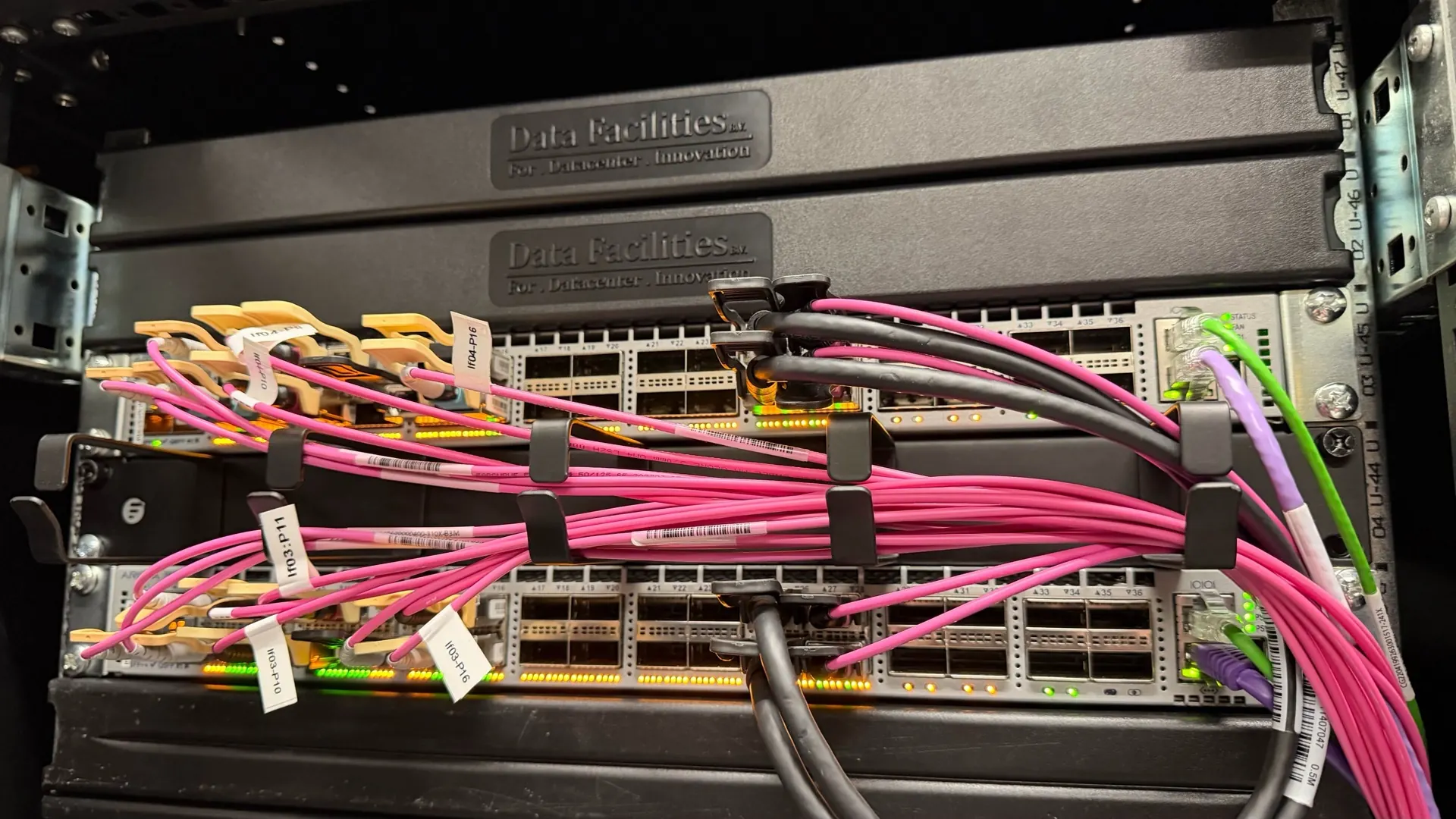
The fabric is built around peering. Native peering and metro transport on every BareFABRIC port; Tier-1 + Tier-2 transit one cross-connect away. Connectivity is a first-class colocation service rather than a supplementary one.
Data Facilities operates THG1 in The Hague — a 3.50 MW carrier-neutral colocation site at the heart of the Dutch metro. Operated by network engineers, audited continuously, and designed for sustained operation through the second day of an outage.
Data Facilities was founded in 2012 with the acquisition of a former EDS HP data center in Spijkenisse, retrofitted from the ground up for modern colocation. From that first site, the operating model was defined: engineer-led, single-site focused, and audit-ready by design.
What differentiates the facility is not the hardware — it is the operational posture. Every facility decision, contract and audit cycle is owned by the same engineering team that operates the network and takes the on-call phone. There is no first-line ticket queue between the customer and the engineers who resolve the issue.
Today the focus is THG1, our anchor facility in The Hague: 3.50 MW gross capacity, distributed 2N+1 throughout, sealed cold-aisle, built to VRKI 2.0 Class 4. Phase 1 (1.75 MW) is built and live. Phase 2 (+1.75 MW) is scheduled for 2027. Capacity is added against demand rather than ahead of it.
To provide businesses of all sizes with enterprise-grade infrastructure that is reliable, secure, scalable and sustainable, and to operate the critical infrastructure on which their operations depend.
Operator-grade infrastructure should be available to businesses of every size. The objective is to make that infrastructure accessible, accountable and audit-ready for engineering teams of every size.
They are evident in the hardware choices, the contract structure and the operational runbook.
The fabric is built around peering. Native peering and metro transport on every BareFABRIC port; Tier-1 + Tier-2 transit one cross-connect away. Connectivity is a first-class colocation service rather than a supplementary one.
An electrified perimeter, a VRKI 2.0 Class 4 certified alarm system, mantraps on every entry and multi-factor access on every door — designed in from the first drawing, not bolted on.
3.50 MW gross at full build. Phase 1 lives today; Phase 2 scheduled for 2027. Capacity is not built ahead of need; it is added against committed demand and signed reservations.
Renewable-energy sourced, sealed cold-aisle for cooling efficiency, mechanical design distributed 2N+1 alongside electrical — capacity is sized to load rather than over-provisioned. Reporting available under NDA.
A condensed timeline of the progression from one acquired room to the THG1 build, with each step documented in audit and in the operational baseline.
Data Facilities is founded with the acquisition of a former EDS HP data center in Spijkenisse, retrofitted for colocation. First customers were onboarded within months.
A second dark-fiber carrier terminates inside the facility. Customers obtain physical path diversity within the building.
First ISO 27001 audit cycle completed. Information security management documented end-to-end, evidence retained for procurement and audit teams.
Data Facilities merges with the Colohouse group. Operations scaled across a wider footprint while the engineering culture and customer relationships were retained.
Data Facilities separates from the Colohouse group. The business became a focused, independently-run operator with its own commercial roadmap.
Ellada acquires the real estate of the The Hague data center and announces the 3.5 MW expansion program. A phased build to 3.50 MW gross, distributed 2N+1 throughout, designed to operator-grade standards.
THG1 Phase 1 build completes — 1.75 MW live, sealed cold-aisle, distributed 2N+1, ready for tenants. ISO 9001:2015 and ISO 27001:2022 renewed in August; SOC 2 Type II audit window closes in November.
Public launch of BareFABRIC — a metro fabric spanning ten locations with native peering and metro transport included on every port. Zone B build completes the same year; perimeter, intrusion detection and access control upgrades land on the back of the Phase 1 footprint.
THG1 Phase 2 brings the build to 3.50 MW gross. Capacity reservations are open against the Phase 2 envelope.
Reliability, trust and excellence are commonly stated values. The following are the values applied when a contract clause or a runbook step is genuinely ambiguous.
Solutions matched to the client's operational goals rather than to an internal sales mix.
Consistent, reliable services that businesses can plan around.
Adapting to market shifts with scalable offerings.
Collaboration with customers, partners and the wider ecosystem.
Responsible and environmentally sound practices applied end-to-end.
Adoption of technologies that make a measurable difference.
Maintaining the highest standards — in audit, in operations, in customer experience.
Protecting data and systems with audited safeguards.
Acting with integrity, clarity and accountability — in pricing, in reporting, in incidents.
Data centers are energy-intensive by definition. The objective is to make every kilowatt productive: sealed cold-aisle containment, N+1 CRAC tuning, and capacity sized to load rather than over-provisioned. Procurement teams running RFP diligence can request energy mix, PUE and consumption reporting under NDA.
Tours are conducted by an operations engineer. Engineering teams are welcome to attend, and detailed technical questions can be addressed during the tour.


