Standard (5–8 kW)
Default profile, covering mainstream colocation footprints: network operators, MSPs, and regional cloud builds. Cold-aisle containment is the baseline.
Cold-aisle containment, room-level humidification, N+1 CRAC redundancy. Density profiles up to 20 kW per cabinet, air-cooled. Distributed 2N+1 mechanical alongside electrical.
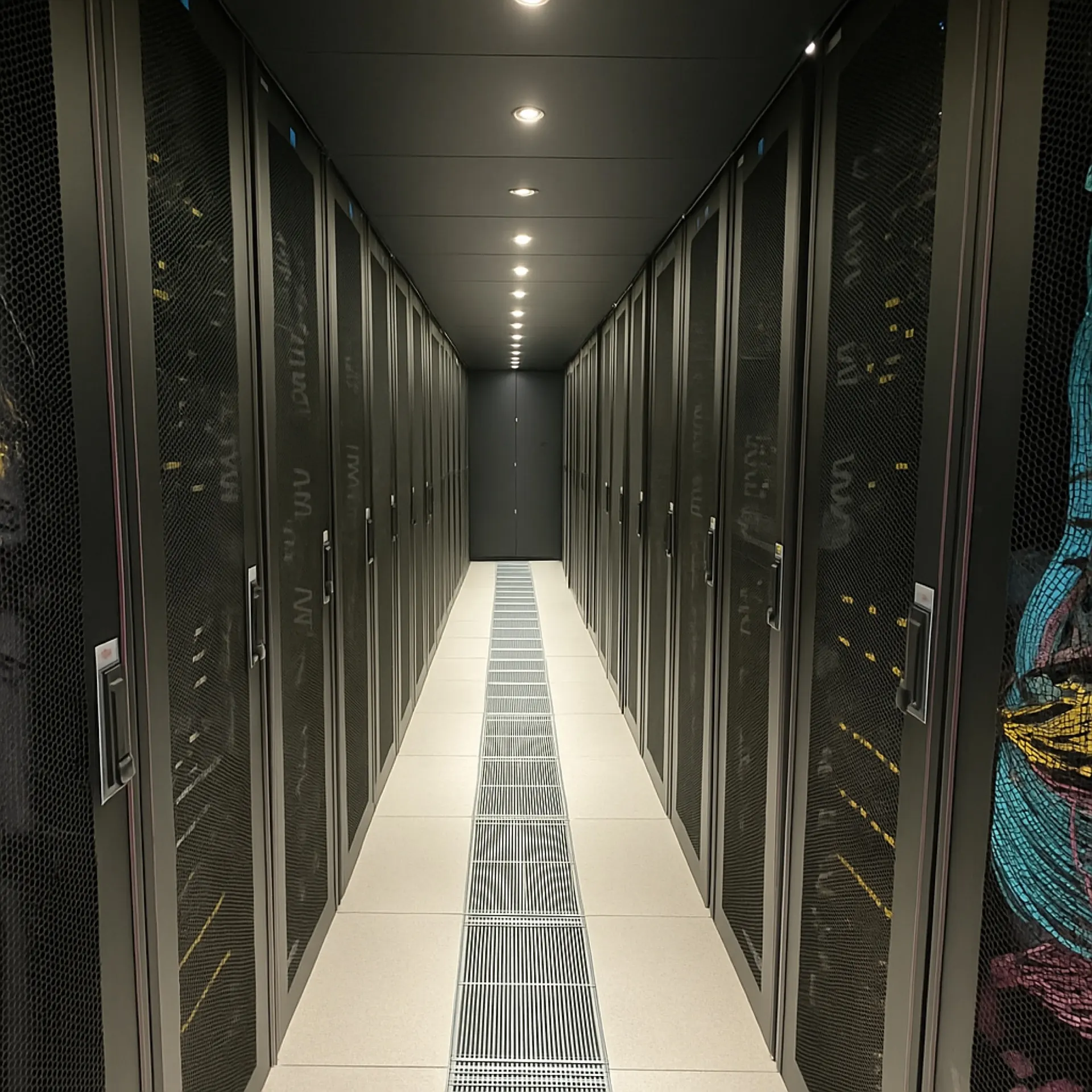
THG1 is sized for the high end of the density profile rather than the average. 20 kW per cabinet air-cooled is supported across the floor today, with sealed cold-aisle containment and N+1 CRAC redundancy.
Room-level humidification is active and maintained inside ASHRAE allowable. A CRAC unit can be taken out for service without thermal impact on the floor. Mechanical design is distributed 2N+1, matching the electrical posture.
Cabinet airflow is managed at the rack: blanking panels are mandatory, hot-air return paths are sealed, and customer equipment is laid out front-to-back without exception.
Three density envelopes, all served by the same cooling design.
Default profile, covering mainstream colocation footprints: network operators, MSPs, and regional cloud builds. Cold-aisle containment is the baseline.
Cloud and IaaS deployments and content delivery clusters. The cabinet and containment are unchanged, with additional capacity reserved for the cabinet feed.
AI training nodes, dense GPU clusters, and sustained inference fleets. Air-cooled. Cabinet placement is engineered for the heat profile.
Sealed cold-aisle, with blanking panels mandatory and hot-air return paths sealed. Customer equipment is laid front-to-back; front-to-back airflow is policy.
N+1 CRAC across the floor. A unit can be removed for service without thermal impact. Failure modes are documented in the operational baseline.
Room-level humidification is active and maintained within the ASHRAE allowable envelope. It is logged continuously, with alerts raised on excursion outside the envelope.
For dense and high-density deployments, our engineers work with your team on cabinet placement, feed sizing, and airflow. A submitted equipment list and rack plan receives a deployment proposal in response.


